From Syria to Zambia, our researchers are bringing frontline evidence to the global stage.
This week in San Francisco, thousands of researchers, practitioners, and policymakers are gathering for the 2026 Annual Conference of the Comparative and International Education Society (CIES). The theme — Re-examining Education and Peace in a Divided World — reflects a moment of profound reckoning in our field, and one that resonates deeply with the work STS does every day.
————–
School-to-School International is presenting in six sessions across the conference, spanning topics from crisis-context learning assessment to pre-service teacher education to early childhood quality measurement. Together, they represent the breadth of STS’s evidence-based approach and our ongoing commitment to research that travels from the classroom to the policy table.
Here’s a look at each session:
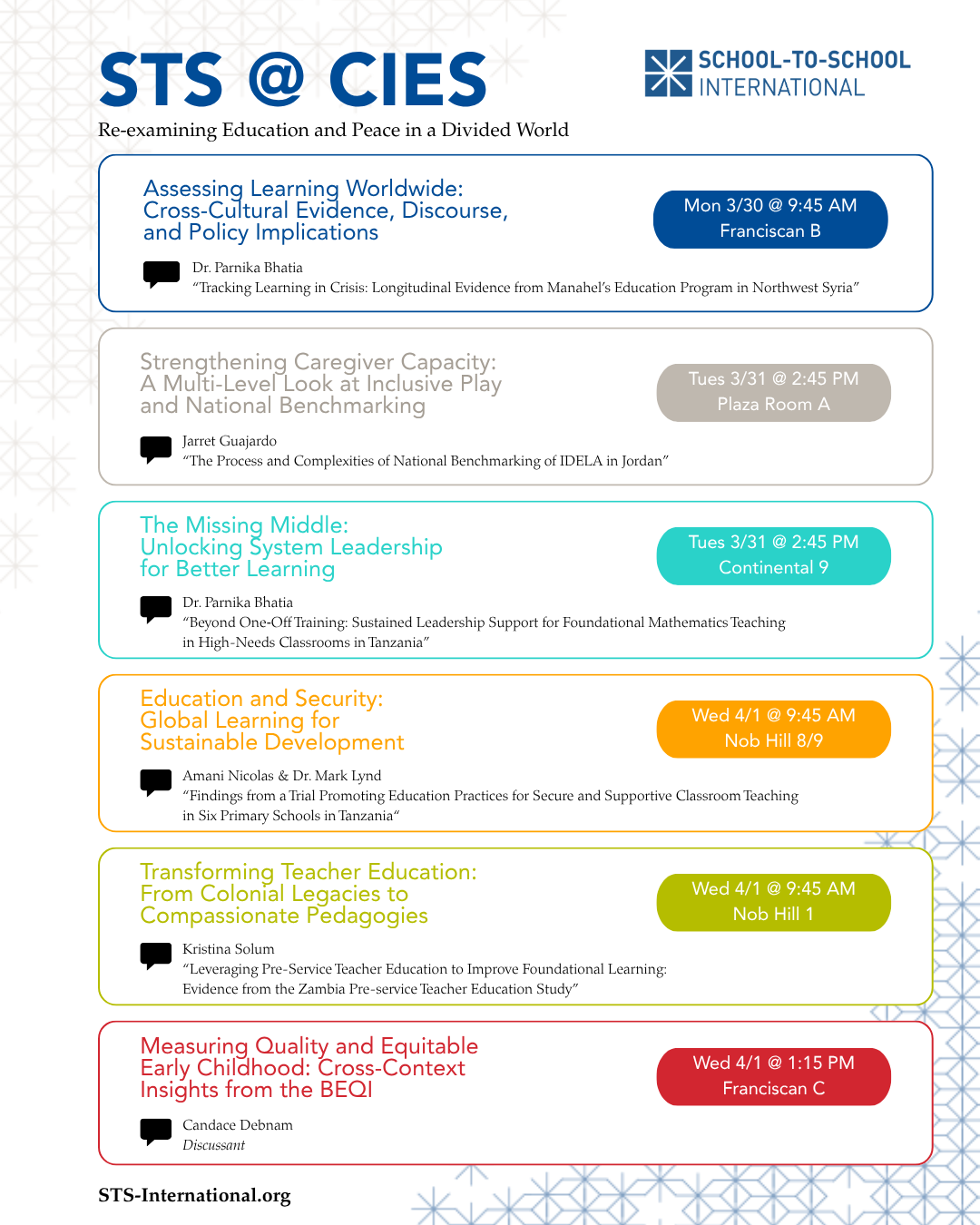
Tracking Learning in Crisis: Longitudinal Evidence from Manahel’s Education Program in Northwest Syria
Dr. Parnika Bhatia, Presenter
Matt Murray, Co-Author
Panel: Assessing Learning Worldwide: Cross-Cultural Evidence, Discourse, and Policy Implications
Monday, March 30 · 9:45 AM · Franciscan B
Measuring learning in active conflict zones is among the most methodologically and logistically complex challenges in the field. Dr. Bhatia presents longitudinal findings from STS’s work with the Manahel education program in northwest Syria — a setting where evidence on student learning progress is not just difficult to gather, but critically important. This presentation speaks directly to the conference’s core question of what education looks like when peace is absent.
The Process and Complexities of National Benchmarking of IDELA in Jordan
Jarret Guajardo, Presenter
Panel: Strengthening Caregiver Capacity: A Multi-Level Look at Inclusive Play and National Benchmarking
Tuesday, March 31 · 2:45 PM · Plaza Room A
The International Development and Early Learning Assessment (IDELA) is a globally-used tool for understanding young children’s development — but adapting and benchmarking it at the national level is far from straightforward. Jarret Guajardo shares the complex, collaborative process STS undertook with the ASAS project in Jordan, offering lessons for practitioners seeking to ground global tools in local realities. A timely contribution as national benchmarking expands across the sector.
Beyond One-Off Training: Sustained Leadership Support for Foundational Mathematics Teaching in High-Needs Classrooms in Tanzania
Dr. Parnika Bhatia, Presenter
Panel: The Missing Middle: Unlocking System Leadership for Better Learning
Tuesday, March 31 · 2:45 PM · Continental 9
Professional development that ends with a training workshop rarely sticks. Dr. Bhatia explores what sustained, embedded leadership support looks like in practice — and what it takes to shift foundational math teaching in Tanzania’s most under-resourced classrooms. This research, from the Tanzania Numeracy Research Project, speaks to the “missing middle” of education systems: the school leaders and mid-level coaches whose consistent presence can make or break instructional quality.
Findings from a Trial Promoting Education Practices for Secure and Supportive Classroom Teaching in Six Primary Schools in Tanzania
Amani Nicolas, Co-Author
Dr. Mark Lynd, Presenter
Panel: Education and Security: Global Learning for Sustainable Development
Wednesday, April 1 · 9:45 AM · Nob Hill 8/9
Can intentional classroom practices build psychological safety — and does that safety translate into better learning? Amani Nicolas and Dr. Mark Lynd share early findings from a structured trial across six Tanzanian primary schools, where STS tested approaches designed to foster security and support in everyday instruction as part of the Whole Child Model work. This session bridges the conference’s peace theme with practical, school-level implementation evidence.
Leveraging Pre-Service Teacher Education to Improve Foundational Learning: Evidence from the Zambia Pre-service Teacher Education Study
Kristina Solum, Presenter
Panel: Transforming Teacher Education: From Colonial Legacies to Compassionate Pedagogies
Wednesday, April 1 · 9:45 AM · Nob Hill 1
Teacher education systems across sub-Saharan Africa are at a crossroads — and Zambia offers a compelling case study. Kristina Solum presents findings from STS’s study of pre-service teacher education reform in Zambia, where shifts in how new teachers are trained are showing measurable impacts on foundational learning outcomes. This session connects directly to STS Zambia’s growing leadership in the sector and complements the RISE program’s broader commitment to teacher capacity.
Measuring Quality and Equitable Early Childhood: Cross-Context Insights from the BEQI
Candace Debnam, Discussant
Wednesday, April 1 · 1:15 PM · Franciscan C
Candace Debnam joins this panel as a discussant, bringing STS’s experience in early childhood measurement and equity-focused assessment to a comparative, cross-context conversation. The session centers on the Benchmarks for Early Childhood Quality and Inclusion (BEQI), a framework for understanding and improving quality across diverse early learning settings. Candace’s role as discussant reflects STS’s standing in the global early childhood development community.
————–
STS’s presence at CIES 2026 reflects the range and rigor of our research portfolio — and our belief that evidence, honestly gathered and honestly shared, is one of the most powerful tools we have for improving children’s lives. We’re proud to bring the voices of learners and teachers from Tanzania, Zambia, Syria, Jordan, and beyond into these conversations.
Follow us on LinkedIn for updates throughout the conference week.