
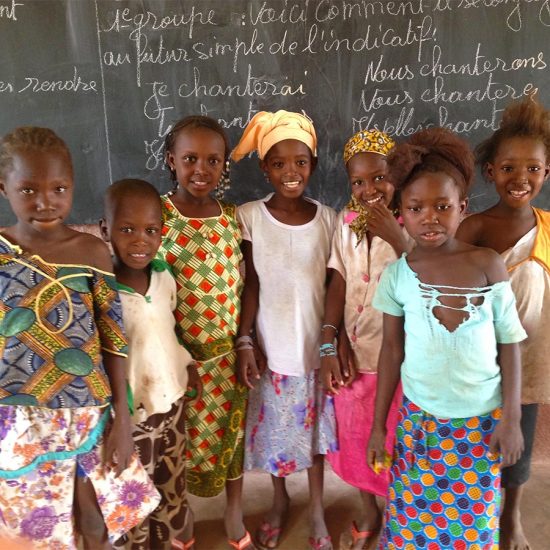
Mali Girls’ Leadership and Empowerment through Education
Winrock International and its partners, including EdIntersect, are implementing the multi-year, USAID-funded Mali Girls’ Leadership and Empowerment through Education (GLEE) Program. USAID GLEE builds upon other programs to support and leverage efforts by the Government of Mali and civil society to increase girls’ educational opportunities in the regions of Mopti and Kayes.
STS collaborated with EdIntersect at various stages of the project, including the project’s baseline and endline, as well as a mid-project study. In 2018, STS was responsible for managing the baseline study by collecting and analyzing data from a household survey of parents and girls aged 8-18 in 80 villages, an inventory of all 272 schools in the project area, and regional Ministry of Education administrative records. The study provided a greater understanding of girls’ socioeconomic status and schooling histories at a household level; explored the knowledge, attitudes, and practices regarding girls’ schooling; and measured baseline levels of key indicators. STS designed the study; developed data collection tools in English and French; oversaw translation to Bambara, Soninke, and Peul; programmed the tools electronically; trained data collectors on random route sampling procedures and electronic data collection; monitored data collection; and analyzed all results for the baseline study report.
For the mid-project study in 2020, STS partnered with EdIntersect and Malian research firm CERIPS to assess which of the project’s approaches were working well in each region, as well as the factors required for adolescent girls to access education and to transition into formal schools. Special emphasis was placed on programmatic approaches in conflict zones. The mid-project research study employed qualitative methods, supported by the analysis of secondary, quantitative data supplied by the project. STS’s work allowed the project team to measure performance, understand the reasons behind the project’s successes and challenges, and adapt interventions to the high-conflict zone of Mopti. More broadly, the evidence generated from STS’s research helped USAID adjust GLEE’s design for new locations throughout Mali. Finally, the research allowed stakeholders—particularly government and NGO stakeholders—to design and implement better education programs for adolescent girls.
For the endline study, STS was responsible for the qualitative portion of the endline performance evaluation. The evaluation team collected data from a variety of GLEE stakeholder respondent groups using data collection methods such as semi-structured key informant interviews (KIIs) to gain understanding of multiple perspectives, as well as enable triangulation of data and findings. In addition, the team conducted focus group discussions (FGDs) with beneficiaries and project participants at ten schools across the three intervention regions. The research team also reviewed existing GLEE project data and endline quantitative data collected by EdIntersect to supplement qualitative findings. Combining the qualitative and quantitative results, STS drafted and finalized the final report.
The evidence generated from STS’s research helped USAID assess project’s relevance, effectiveness, efficiency, and sustainability and allowed key stakeholders—including beneficiaries—to inform the design and implementation of future education programs for adolescent girls in Mali.
In partnership with EdIntersect, Winrock International & USAID
Related Resources
Dates: 2018 – 2023