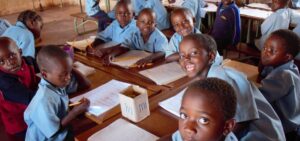
Since 2022, School-to-School International has worked with teachers in Tanzania on a strategy called flexible grouping, where teachers break students into groups to learn.
Why have we been doing this?
One reason is that a tenet of good pedagogy is to vary instructional approaches: Don’t just stand there and present information like the high school economics teacher in Ferris Bueller Day’s Off. Engage your learners through lively question and answer, group discussions and tasks, and group presentations.
STS also advocates organizing students in groups because, as the Russian psychologist Lev Vygotsky taught us nearly a century ago, we learn best from more knowledgeable others (MKOs). It’s easier to learn when these individuals with more knowledge about a concept use terms we understand. MKOs can be adults, but our peers are often the best MKOs. In the 1985 movie Mask, the character Rocky Dennis does a marvelous job illustrating this principle, recounting the beginning of the Trojan War in terms that immediately resonate with his classmates.
Our challenge in Tanzania has been twofold. First, many teachers are inclined to use “the frontal method,” as they say in French-speaking African countries, standing in front of the class and going on and on. When STS conducted a baseline in our two current focus schools, this pattern was the norm, with teachers leading activities like reading syllables (on and on) while students sat in rows, never in groups, pairs, or individually. Second, even if teachers try to organize groups, they sometimes struggle with 100 students per class or more.
To change this norm, we proposed a strategy called “flexible grouping.” In this method, teachers start with whole-class instruction and then ask their students to continue learning in groups. After a time, teachers assess learners in groups and, finally, regroup the learners based on assessment results to include an MKO. In our first attempt, we trained 18 teachers in six schools, and all but one of the teachers started organizing their learners in groups. The last step—identifying an MKO within each group—proved difficult. Two-thirds of these teachers struggled to correctly analyze assessment results and regroup students based on these results.
Flexible grouping includes four steps:
1. Teachers start with whole-class instruction
2. Students continue their learning in groups
3. Teachers assess learners in groups and identify MKOs
4. Teachers regroup learners based on assessment results
And we learned. When we did our second training on flexible groupings in two new schools, we provided teachers templates for tracking individual students by assessment results, calculating averages, and reorganizing groups based on these assessments. This time, instead of two-thirds of teachers struggling with calculations and regrouping, all teachers correctly calculated results and regrouped their students based on assessment results. In at least one instance, a teacher assigned a student to a remedial group based on one round of assessments, but after observing the student’s progress after another round, she assigned the student to a different, nonremedial group.
Why is regrouping such a big deal?
Many critics have argued that flexible grouping is regressive because it puts students in groups that can lead to lowered expectations. This is especially true when students are placed in remedial groups and stay there. Our evidence, though nascent—we will continue tracking this—suggests that flexible grouping need not “segregate” children into low-performing groups when done flexibly with frequent regroupings.
For our work in Tanzania, we are hopeful this approach will yield two other benefits. First, students will have an opportunity to engage in lively co-learning activities and discussion. Second, teachers will have an opportunity to conduct more frequent assessments—not only at the end of term or school year—thereby catching students when they are struggling and offering help then, when it is needed, so their students can move on in their learning.
In November, we plan to see how teachers have applied flexible grouping over the past year. As a follow-up to our baseline, we will quantify how much teachers are actually varying their instruction using learning groups and, most importantly, tracking their learners’ progress so they can offer the kind of support—both enriching and remedial—needed to help all their students learn.